The Role of Medical Illustration and Artistry in Reconstructive Surgery
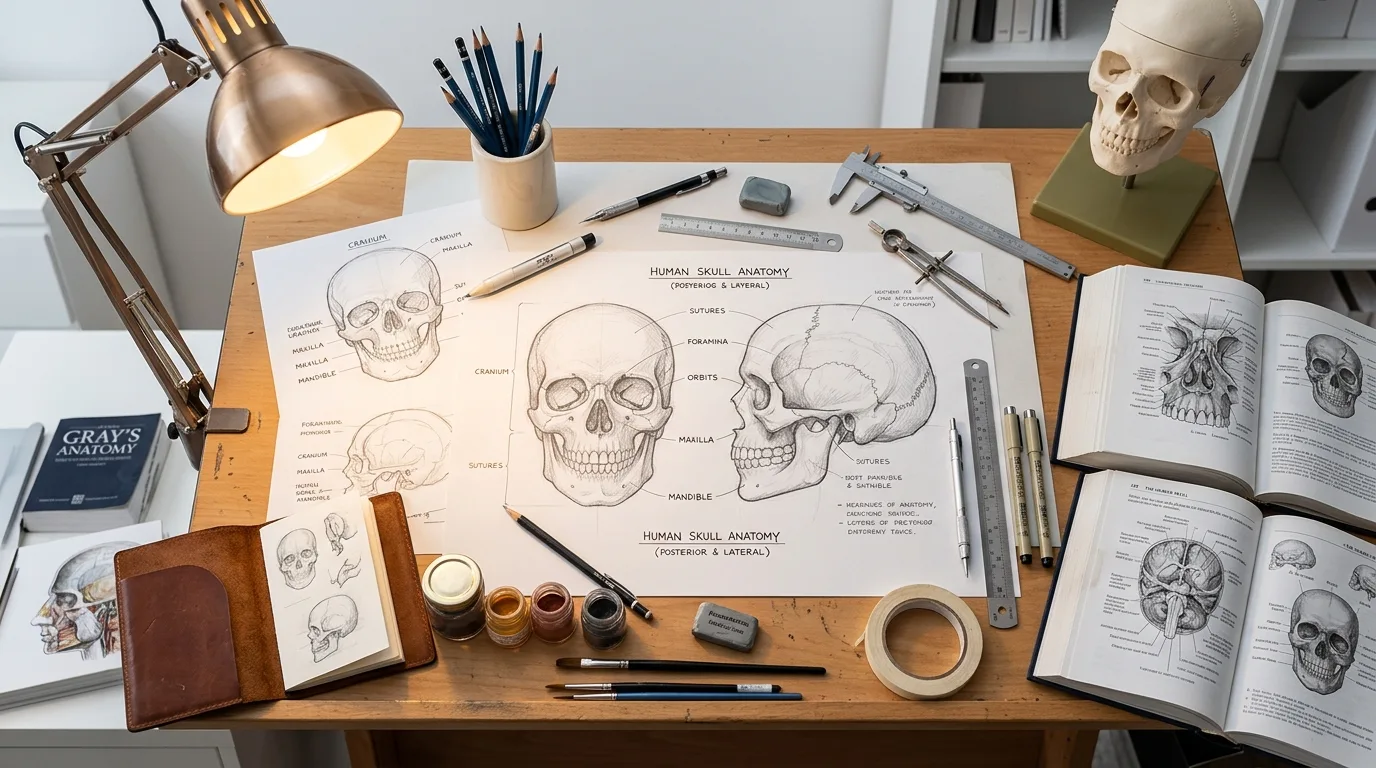
In the development of patient-specific cranial implants, computational tools have become foundational: CT-derived geometry, CAD software, and computer-aided manufacturing are now standard components of the fabrication pipeline. Yet for the most anatomically complex cases, an often-underappreciated discipline contributes meaningfully to final implant quality: medical artistry.
Trained medical illustrators and sculptors bring a working knowledge of human anatomy alongside fine motor skills developed through formal study of biological structures. In the context of cranial implant design, this expertise addresses a gap that automated segmentation and algorithmic surface modeling do not fully close, the gap between technically derived geometry and the nuanced, three-dimensional form of an individual patient’s skull.
Where Automation Falls Short
Automated segmentation of CT imaging data is highly effective for standard anatomical presentations. Software tools can rapidly identify bone boundaries, generate surface meshes, and produce implant geometries aligned to defect margins. For straightforward cases involving clean, well-defined defects with consistent surrounding bone, this workflow is efficient and reliable.
Complex cases introduce variables that degrade automated output quality. Patients presenting for cranioplasty often have prior surgical histories involving titanium mesh, fixation hardware, or earlier implants. Metal artifacts in CT imaging scatter signal across adjacent structures, obscuring true bone margins and producing irregular surface artifacts in digital models. Bone fragments retained within or adjacent to a defect introduce additional geometric complexity. In cases involving frontal sinus anatomy, orbital rims, or the temporal fossa, the underlying three-dimensional form is inherently intricate and varies considerably between individuals.
In these scenarios, automated geometry requires correction. The question is whether that correction is performed computationally, manually, or through a combination of both.
The Medical Artist’s Contribution
A medical artist working in cranial implant design approaches the problem as both a scientific and a craft challenge. Working from CT data, physical casts when available, and reference anatomy, the artist refines implant geometry to achieve the contour continuity and dimensional accuracy that automated tools approximate but may not achieve.
Hand-sculpting of physical prototypes, typically in wax or another workable medium, allows the artist to evaluate form in three dimensions in real time, incorporating subtle corrections to curvature, edge profile, and surface transition that are difficult to specify parametrically. This tactile, iterative process produces a geometry that can then be digitized and used to drive final fabrication.
The discipline of medical illustration itself provides relevant grounding. Illustrators trained in anatomical rendering develop an accurate internalized model of skeletal form, proportional relationships, and regional variation. This knowledge base informs decisions about how a restored cranial contour should appear and function, not only in terms of filling a defect, but in terms of restoring the aesthetic and structural continuity of the skull as a whole.
Application to Specific Defect Types
The contribution of medical artistry is most evident in defect types that challenge computational approaches.
Large bilateral frontal defects, which span the midline and affect the forehead contour visible under the scalp, require careful attention to symmetry and projection. Small asymmetries that automated tools might propagate from imaging artifacts translate into visible or palpable irregularities in the final implant. An experienced medical artist working on such a case applies judgment about bilateral symmetry that a purely data-driven workflow does not automatically provide.
Defects involving prior mesh (where titanium or synthetic mesh was placed as a temporary or permanent measure) present geometry that automated tools often struggle to interpret cleanly. The mesh itself may be deformed, partially incorporated into tissue, or misregistered in imaging. Designing an implant to fit over, around, or in replacement of such mesh requires spatial reasoning about a three-dimensional problem that benefits from human interpretation.
Frontal sinus involvement is another complexity requiring nuanced handling. The posterior wall of the frontal sinus, when preserved, creates a boundary condition for the implant that varies in position and curvature between patients. Matching the implant’s inferior geometry to this structure without creating dead space or sinus communication depends on accurate interpretation of the imaging and careful shaping of the implant’s inferior margin.
Integration with Digital Fabrication
The inclusion of medical artistry in the implant design process does not replace digital fabrication; it refines the input to it. The output of the artist’s refinement process is a physical or digitized geometry that enters the same CAD-to-manufacturing pipeline used for computationally derived designs.
This hybrid workflow (computational baseline, expert manual refinement, digital fabrication) represents one approach to achieving reliable fit in high-complexity cases. It acknowledges that some categories of anatomical reconstruction benefit from human perceptual and spatial reasoning capabilities that current automated tools do not replicate.
For manufacturers specializing in difficult implant cases, the investment in medical artistry expertise reflects a positioning choice: to address the cases that general-purpose fabrication workflows handle poorly, and to deliver implant fit quality that supports efficient surgical execution even in anatomically demanding scenarios.
Broader Implications for Reconstructive Device Design
The integration of artistic and scientific expertise in medical device design is not unique to cranioplasty. Prosthetics, maxillofacial reconstruction, and orbital floor repair all involve structures where the aesthetic and functional demands on a device require both technical precision and an understanding of anatomical form that extends beyond engineering parameters alone.
As digital tools continue to improve, with advances in AI-assisted segmentation, generative geometry optimization, and high-resolution additive manufacturing, the role of manual artistry in the workflow will evolve. But the underlying requirement it addresses, the need to produce implants that accurately represent individual human anatomy in three dimensions, will remain central to the discipline of patient-specific reconstruction.
For related discussion of fabrication materials and case complexity, see the companion articles on CT-to-implant design workflows and bilateral craniotomy and frontal bone reconstruction.